Bathrobe vs. Dressing Gown – Is There a Difference?
Short answer: In everyday speech, bathrobe and dressing gown are used interchangeably, and in practice they are the same garment. Traditionally, though, a bathrobe is an absorbent towelling gown for after a bath, while a dressing gown can be thinner and is mostly about warmth and comfort.
The traditional difference
A bathrobe is made to dry you: thick, absorbent towelling with loops that take up water. A dressing gown is made to keep you warm: it can be thin, smooth and with no absorbency at all. The difference lies in the job, not in the cut or the length.
Why the words got mixed up
Few people own two gowns, so most use the same one for both purposes. Shops have followed the language and today call the same product both names. In practice it is the fabric and not the name that decides what the gown can be used for.
How to decide what you need
If the gown is to dry you when you come out of the bath, choose towelling. If it only has to keep the warmth over breakfast, a thinner fabric works. Used for both, which most people do, a mid weight towelling gown is the most useful choice all year.
Bamboo solves both jobs
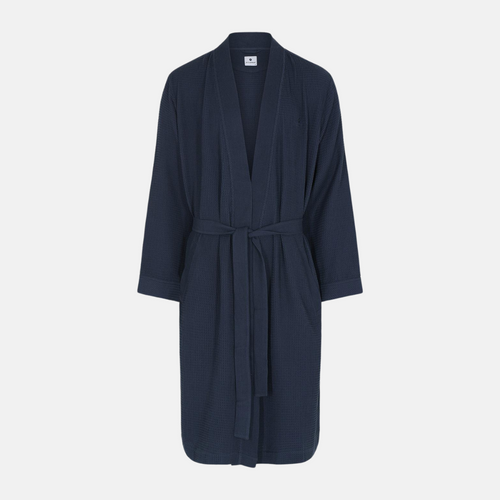
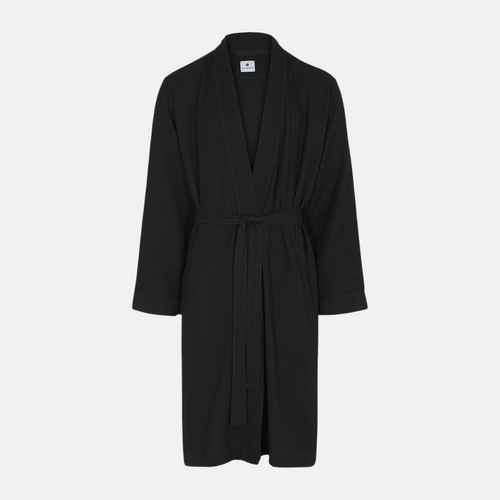
Bamboo towelling absorbs water quickly like a bathrobe and breathes at the same time like a thin dressing gown. One gown in that material therefore covers both needs. See the range under bamboo dressing gowns for women and bamboo dressing gowns for men.
The weight is felt after a bath
A thick cotton gown turns heavy once it has absorbed water and hangs on the shoulders for the rest of the morning. Bamboo towelling absorbs as much but carries the moisture to the surface, where it evaporates. The gown therefore feels dry again after ten minutes rather than an hour.
The towel comes first
Whatever the gown is called, dry yourself with a towel first. A gown is not meant to take up all the water from a whole body. See bamboo towels in the same quality, so both steps of the routine work with and not against each other.
Length and pockets
The name says nothing about the length. Both bathrobes and dressing gowns come to the knee and to the ankle, and the knee length is the most practical in both cases. Pockets and a belt in loops matter more in daily use than what the gown is called.
Washing whatever the name
Wash the gown at 40 degrees without fabric softener, which lays a film in the loops and ruins the absorbency. Hang it over two hooks so the shoulder is not pulled crooked by the weight. Dry it fully in between, or it starts to smell after a few days. See also better sleep with bamboo bedding and nightwear.
Frequently asked questions
Is there a difference between a bathrobe and a dressing gown?
Traditionally yes: a bathrobe is absorbent towelling, a dressing gown can be thin. Today the words mean the same, and the fabric makes the difference.
Which should you choose?
A mid weight towelling gown if it is to be used for both. That is what most people do, and a thin gown cannot dry you after a bath.
Can a gown replace the towel?
No. Dry yourself with a towel first and let the gown take the rest. A gown cannot absorb the water from a whole body at once.
See our range of bamboo dressing gown for men.