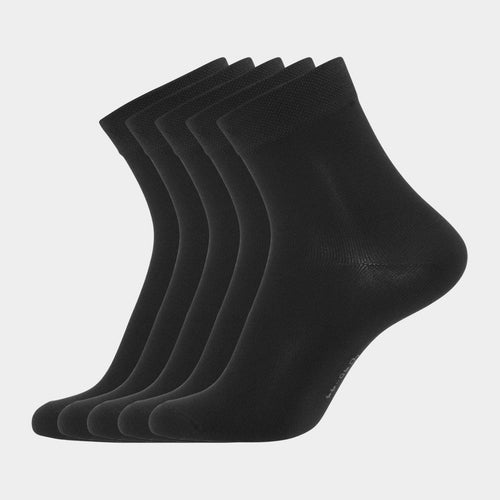
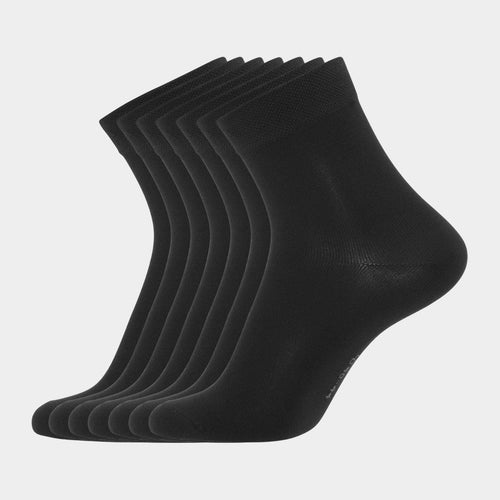
Black bamboo socks and why they go grey
Short answer: Black socks turn grey from mechanical wear and heat, not from the detergent. The fibres on the surface break up and reflect light differently, and the eye reads that as grey.
Wear rather than fading
The colour sits inside the fibre. What changes is the surface, which becomes rough from friction in the machine as the socks rub against each other and the drum. A full drum creates more friction than a half full one, so do not overload the machine. See all bamboo socks for men.
Turn them inside out
Inside out means the friction hits the inside rather than the side you see. It is the simplest step that works, and it costs nothing. Make it a habit when you take your socks off in the evening, so they are already the right way round in the laundry basket.
Fabric softener makes it worse
Fabric softener leaves a thin film on the fibres, and that film scatters light so black looks dusty. Leave it out entirely for socks. Bamboo viscose is soft on its own and does not need it. If you have used softener for a long time, a few washes without it can help. See washing and care.
Do not wash black and white together
New black socks release a little dye in the first few washes, and white socks turn greyish from it. Keep them apart for the first five washes, then wash black with other dark clothes. That protects both the light socks and the black ones. See bamboo socks for men.
Heat affects the surface
High temperatures make fibres more vulnerable to friction, and the tumble dryer is where heat and rubbing meet. Wash black socks at 30 or 40 degrees and hang them to dry. They dry quickly, and the surface stays smoother when they are not tumbled in hot air.
Less detergent is enough
Too much detergent does not rinse out fully and can leave residue that makes black look dull. Follow the dosage for a lightly soiled load, since socks are rarely very dirty. A liquid detergent for dark clothes dissolves well at low temperatures and is a sensible choice for black socks.
Lint from other clothes
Towels and fleece shed lint that settles on black socks and makes them look grey from a distance. It is not wear, but it looks like it. Wash socks with smooth fabrics rather than towels. A lint roller removes most of it if the damage is already done.
Wear from the shoe
There is friction inside the shoe too. The heel and toe rub against the lining all day, which is why they often turn grey before the rest of the sock. It cannot be avoided entirely, but shoes that fit well mean less movement and less wear. Rotate between several pairs of shoes.
What to expect
Black socks will get slightly lighter over time, however you wash them. Inside out, at a low temperature, without softener and without the dryer, they keep their colour much longer. If you buy the same model again, you can mix new and old pairs as long as the difference is small.
Frequently asked questions
Why do black socks turn grey?
Because the surface wears rough and reflects light differently. The colour is still in the fibre, but the rough surface makes the sock look lighter and duller.
Does washing inside out help?
Yes. The friction hits the inside rather than the side you see, and it is the simplest way to keep black socks dark for longer.
Can grey socks become black again?
Not fully. The surface cannot be restored, but softener residue can be washed out, which helps the colour a little, especially after long use of softener.
See our range of men's bamboo socks.