Colour fastness to sweat
Short answer: Sweat is mildly acidic or alkaline and contains salts. If the dye is not bonded well enough, sweat can loosen it, and the colour changes where you sweat most. Colour fastness to sweat is measured in a lab on a scale from one to five.
Sweat is more than water
Sweat looks like water, but it contains salts and is mildly acidic or alkaline. That combination can affect a dyed fabric. You only feel it as damp, but over time sweat works on the same spot of the garment, and that is where the difference between a well and a poorly bonded colour shows.
Sweat attacks the bond
Salts and acids can weaken the bond between dye and fibre. If the bond is strong, the colour holds. If it is weak, sweat can loosen the dye bit by bit. It does not happen in a day but repeats every time the garment is worn, and the change only becomes clear after it has gone on for a while.
Where it shows first
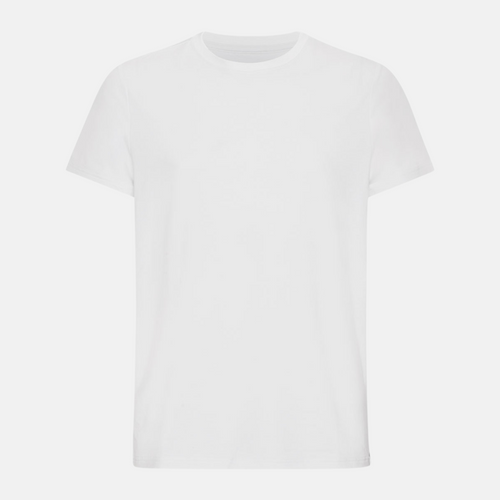
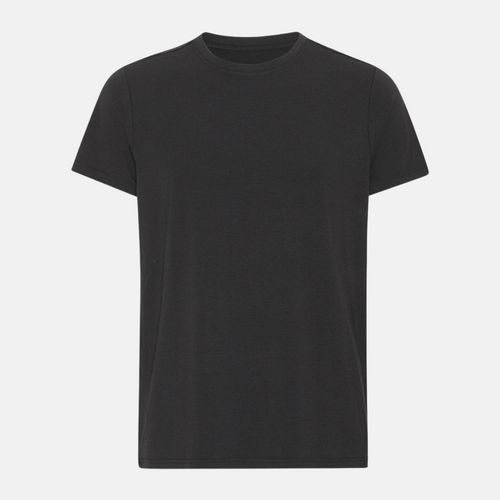
It shows first in the armpits, along bands and at the waistband, the places where the skin is warm and damp and the fabric lies close. Sweat sits longest and works hardest here. A piece can look normal across most of the surface and still have changed colour in exactly those spots. See bamboo t-shirts for men.
The test exists
Colour fastness to sweat is measured in a laboratory with artificial sweat in two versions, an acidic one and an alkaline one. The test exists because sweat is not the same for everyone, and because dyes react differently to acid and alkali. The aim is to know how the colour handles both before calling it durable.
The number from one to five
The result is given as a number from one to five. A high number means the colour changes little, and a low number means it changes more. The number says something about how the colour handles sweat, but nothing about how much you sweat or how long you wear a piece in a row. See bamboo clothing for men.
Why the colour changes unevenly
Because sweat does not spread evenly, the colour change turns patchy. In some places it is clear, in others there is nothing. It is one of the clearest forms of wear on dyed pieces, and it is hard to hide once it has appeared.
The armpit and the deodorant
The armpit often turns lighter than the rest because sweat and deodorant work on the same spot every day. Two things act together in the same small area, day after day. That is not unusual and does not necessarily say anything about the quality of the piece, but you can take it into account in how you wear and wash it.
How to prevent it
Wash the garment soon after use, so the sweat does not get to work for hours. If a sweaty piece hangs in a bag or sits in the basket for days, the sweat has plenty of time to work on the colour. A short stay in the basket and a prompt wash is the simplest protection you have. See also offers on everyday clothes.
Can the colour come back
No. Once the bond is broken, the dye is gone and there is nothing to restore. That is the difference between a piece that is merely dirty and one whose colour has disappeared. Dirt can be washed out, but lost colour cannot be washed back. That is why prevention works, and why colour fastness matters.
Frequently asked questions
Can it be prevented
Wash the garment soon after use, so the sweat does not get to work for hours. Do not leave it damp in a bag or in the basket for days, because the longer the sweat sits, the more it can do.
Why does the armpit turn lighter than the rest
Because sweat and deodorant work on the same spot every day. A small area gets the same strain again and again, while the rest of the piece gets off far more lightly.
Can the colour come back
No. Once the bond is broken, the dye is gone. A piece can be washed clean, but lost colour cannot be washed back, so prevention is what makes the difference for the colour.
You can find the full range at Bamboo-Clothing.com.