How a sock cuff holds without squeezing
Short answer: A sock cuff needs just enough tension to hold the sock up and no more. The answer is a wide, soft rib with an elastic thread spread over several centimetres. That way the sock stays put without leaving deep marks or squeezing the leg.
The cuff should hold and no more
The cuff of a sock has one job: to hold the sock up. It needs exactly enough tension for that, and no more. If it is too loose, the sock slides down. If it is too tight, it presses on the skin and leaves a clear mark. It is a balance that depends on how the cuff is built.
Width spreads the force
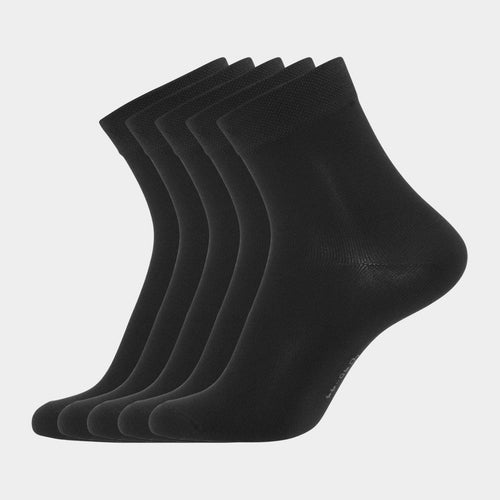
The same grip spread over three centimetres presses far less per square centimetre than over one. That is why wide cuffs feel better. The force is spread over a larger area, and the pressure on the skin is gentler while the sock still stays put. See bamboo socks for women.
The rib gives the stretch
The folds in the rib can be pulled straight, so the cuff can pass over the heel without the yarn being stretched hard. The rib works like a small reserve of fabric that unfolds as you pull the sock on and folds back when you let go. That makes the sock easy to put on and still snug on the leg.
The elastane gives the recovery
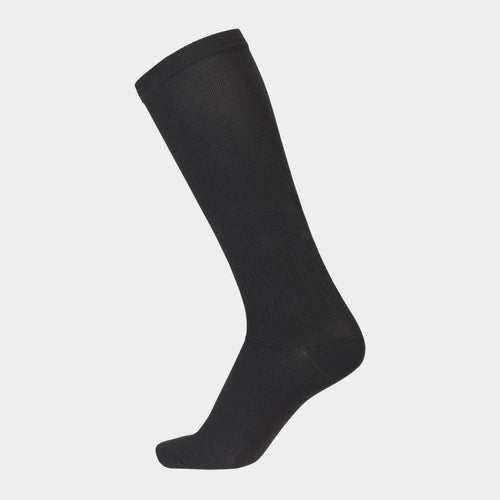
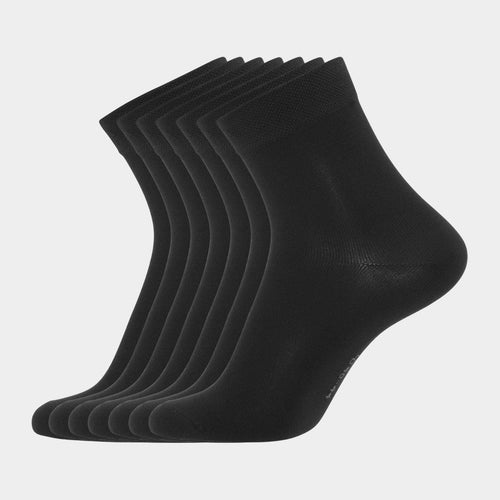
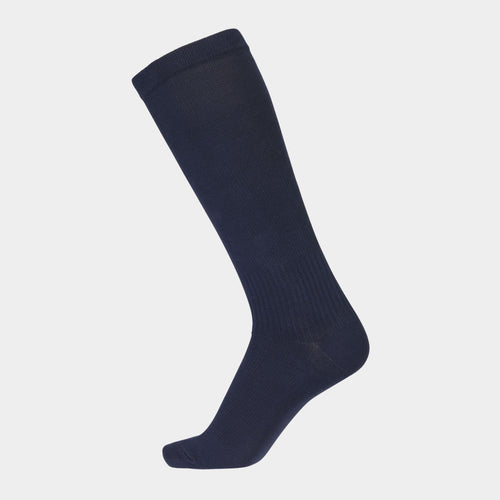
Without an elastic thread the rib would be soft but would not hold. The elastane gives the recovery, so the cuff pulls together around the leg and stays there. The combination of rib and elastane is what works. See bamboo socks for men and all bamboo socks for men.
Where a mark on the skin comes from
A light mark after a day in socks is normal. The skin is soft and takes on the shape of the cuff for a while. The mark usually fades shortly after you take the sock off. If the skin turns red or sore, or the cuff leaves a deep groove, it is too tight. Then the sock is too small or the cuff too narrow for your leg.
How wide should a sock cuff be
Three to five centimetres works well for most people. That is wide enough to spread the pressure without making the cuff hard to pull over the heel. If your ankles or calves are especially strong or slim, try socks with a slightly different cuff width until you find the one that fits.
When the cuff squeezes too much
If the cuff squeezes too much, you do not have to get used to it. Try another size or a model with a wider cuff. If you have problems with your legs, such as swelling, talk to your doctor about which socks suit you. It is better to choose socks that feel comfortable than to put up with it.
Socks without elastic
Are there socks without elastic? Yes, but they slide down straight away and are rarely used. Without an elastic thread the cuff has nothing to pull it together and simply lies slack around the ankle. Most people choose socks with a little elastane, because it gives a cuff that holds and is comfortable.
How to choose and care for them
Choose socks with a wide, soft cuff and check that it sits steadily without pressing. Wash at low temperature and avoid the dryer so the elastane keeps its tension. Rotate between several pairs so each rests between wears. That way the cuff keeps its softness and its ability to hold the sock up for longer.
Frequently asked questions
How wide should a sock cuff be
Three to five centimetres works well for most people. That is wide enough to spread the pressure over a larger area, so the cuff holds without pressing noticeably on the skin.
What if the cuff leaves a mark
A light mark is normal. If the skin turns red or sore, the cuff is too tight, so try another size or a model with a wider cuff that spreads the pressure better.
Are there socks without elastic
Yes, but they slide down at once and are rarely used. Without an elastic thread the cuff has nothing to pull it around the leg, so most people choose socks with a little elastane.