How faulty batches are caught
Short answer: A number of garments are taken at random from the batch, then measured, washed and examined. If the sample has too many faults, the whole batch is stopped before it moves on to the warehouse.
The sample is drawn at random
Inspection starts by taking a number of garments from the batch without choosing them by looks. This happens across cartons and sizes, so the sample reflects the whole batch. If you only take from the top carton, the result says nothing about the rest, so randomness is a fixed rule.
The sample follows a table
How many are inspected depends on the size of the batch. A fixed table states how many garments must be examined and how many faults are allowed before the batch is stopped. The bigger the batch, the more garments are taken, but the number grows more slowly than the batch, so inspection stays affordable.
Measured, washed and examined
Garments are measured against the chart, washed according to the care label and examined for faults in seams, colour and fabric. The wash shows whether the fabric shrinks or loses colour. The measuring shows whether the size holds. Neither can be seen by looking at a garment still folded in its bag.
Faults are weighed differently
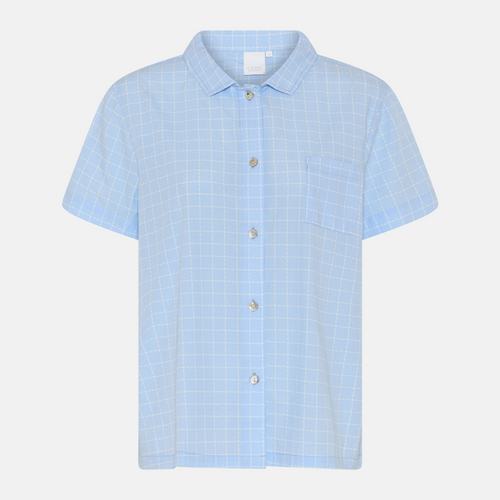
A loose thread and a wrong size are not the same kind of fault. Faults are usually split into minor, major and serious, and serious ones count for more. See bamboo shirts for women, where fit and sewing matter a great deal for the overall impression.
The limit on faults
The table states how many faults may be found in the sample before the batch is not approved. If the number is under the limit, the batch is approved. If it is over, it is stopped. The limit is agreed beforehand between brand and factory, so nobody doubts when a batch is good enough.
A stopped batch goes back
If the batch fails, it is sorted or resewn, and inspected again afterwards. Faulty garments are removed and the good ones move on. Sometimes the fault is so widespread that the batch must be rejected entirely. See offers for women and Moodies if you want to see what is in stock now.
Who inspects
Inspection can be done by the factory itself, by the buyer's own inspector or by an independent firm. The factory's own check is quick, but an outside inspector has no interest in letting faults through. Some use both, so faults are caught during and after sewing.
Inspection during production
Checks at the factory do not only happen at the end. Some faults are caught while garments are being sewn, when a fault can be corrected before the whole batch is finished. It is cheaper to fix a fault on a line than to resew a whole batch afterwards, so checking along the way pays off.
What if a fault only shows at home
Even with inspection, a single garment can have a fault that only shows at the customer's home. Then it is a complaint, handled between shop and customer. Describe the fault, send a photo if you can, and keep the receipt. That makes the case quicker to settle for both sides.
Frequently asked questions
Are all garments inspected?
No. Full inspection is too costly, so samples with fixed rules are used. The rules state how many garments are taken and how many faults may be found before the batch is stopped.
Who inspects?
Either the factory itself, the buyer's own inspector or an independent firm. It depends on the agreement between brand and factory, and some use several of them on the same batch.
What if a fault only shows at home?
Then it is a complaint, handled between shop and customer. Describe the fault, send a photo if you can, and keep the receipt so the case can be settled quickly for both sides.
You can find the full range at Bamboo-Clothing.com.