What overlock means
Short answer: Overlock is a seam that sews the fabric edge together and finishes it at the same time, so it does not fray. It is the most used seam in knitted garments. Here we explain how it is sewn, why it is used so much and where it is not ideal.
What overlock is
Overlock is a seam that both joins two pieces of fabric and finishes the edge in the same pass. It is used to sew clothes together while making sure the fabric does not fray at the edge. You find it in most knitted garments, from T-shirts to jumpers, and most people have seen it without knowing the name.
How it is sewn
Three or four threads run around the edge and bind the two layers of fabric together. The threads wrap around the edge of the fabric while the seam is formed, which is why it can sew and finish the edge in one go. It needs a special machine built for exactly that job, working quickly and evenly.
Why the fabric does not fray
The edge is encased in thread, so the fabric cannot unravel with wear and washing. That is the seam's most important quality. Without a finished edge, knitted fabrics would soon start to run, and the garment would lose its shape. Overlock prevents that and makes clothes last in daily use.
Why it is used so much
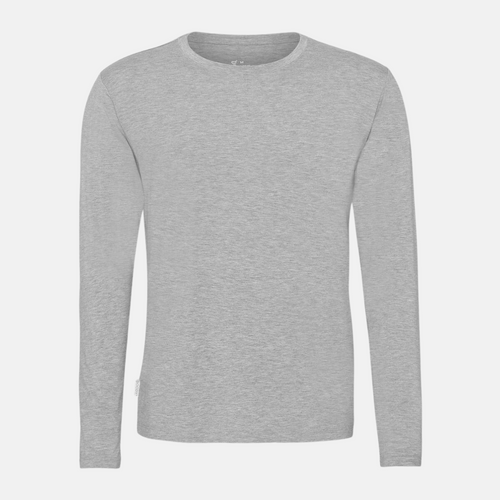
Overlock is quick, strong and stretches with the fabric. That combination makes it the standard choice for knitted garments, where the seam has to keep up when you move. Because it is fast to sew, it also keeps production sensible. See bamboo long sleeve T-shirt for men.
Stretches with the fabric
Knitted fabric gives when you move, and a seam that cannot keep up would break or come undone. Overlock is built to stretch with the fabric and return to its shape afterwards. That is a large part of why it is so common in clothes that must fit and move with the body.
Fully adequate for most things
For anything that does not lie directly against the skin, overlock is fully adequate. It is strong, sits well and can be sewn quickly, and for most garments there is no reason to choose anything else. That goes for tops and outer layers, for example, where the seam lies under another layer. See Bamboo Basics.
Where it is not ideal
Overlock is not ideal in underwear against the skin, where the edge of the seam can rub. Here many makers choose a flat seam such as flatlock, to make the garment more comfortable all day. For most other garments, such as bamboo T-shirt dresses, overlock is a good choice.
How to see it from inside
From the inside you can see an overlock as a dense edge of thread along the seam. The edge often looks a little fuzzy, because it is made of several threads lying side by side. Look at the seam on the inside of your clothes and you will see how common it is, even in pieces you have worn for years.
If an overlock comes undone
If an overlock comes undone, it frays quickly, because the edge is no longer secured. Sew it again at once, preferably by hand with small stitches, before the hole grows. A small repair in good time is far easier than a big one later, and it saves you from throwing the garment away.
Frequently asked questions
Can you see an overlock from inside
Yes, it shows as a dense edge of thread along the seam. The edge is often a little fuzzy, because it is made of several threads running around the edge of the fabric.
What if an overlock comes undone
Then it frays quickly, because the edge is no longer secured. Sew it again at once, preferably with small stitches, so the damage does not grow more than it has to.
Are three or four threads best
Four threads are stronger, while three are more elastic. Which is best depends on the garment and on how much the seam has to stretch when you wear it.
You can find the full range at Bamboo-Clothing.com.