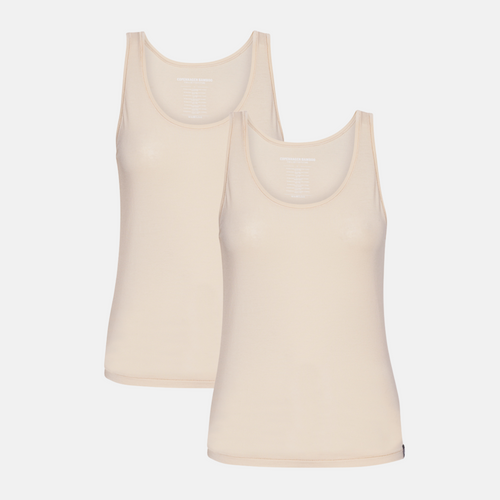
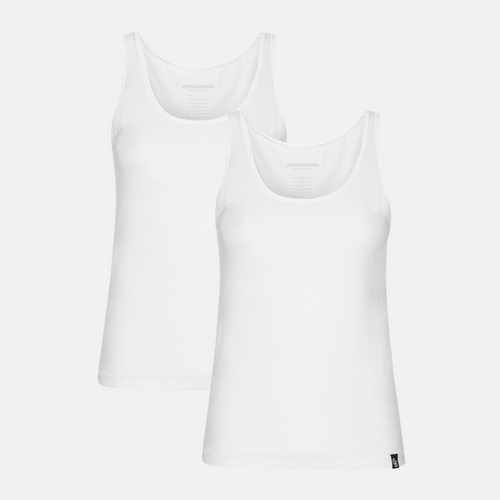
Bamboo tops for training and what makes them usable
Short answer: A training top should stay where it is and not grip the skin when you sweat. The cut decides the first, the material the second.
The cut keeps it in place
A close fitting top does not roll up when you bend, stretch or lie on the mat. A loose one does, and then you spend the session pulling it down instead of training. Choose a length that reaches a little over the waistband of your leggings. See women's bamboo activewear.
Close fitting without squeezing
Close fitting does not mean tight. The top should follow the body, but not press across the bust or under the arms. If you can lift your arms above your head without the hem riding up over your stomach, it fits. If it pulls at the armhole, it chafes once you have sweated a while.
The fabric against clinging
Bamboo viscose moves moisture away from the skin instead of holding it between skin and fabric. That is why the top does not cling the way a fabric that traps moisture does. The skin feels drier, and the top glides as you move instead of sticking.
For low and moderate intensity
Yoga, pilates, walking and strength training at a calm pace are where bamboo works best. With heavy, prolonged sweating the fabric becomes saturated and dries more slowly than technical polyester. For long runs or spinning in the heat, a technical fabric is often the better choice.
Seams and edges
Seams that rub are felt more when the skin is damp. Look for flat seams at the shoulder and side, and check that the label does not rub at the neck. Soft edges at the neckline and armholes do more for comfort than you might think, especially in exercises with a lot of arm movement.
A layer for warming up
A thin top on its own can feel cold at the start of a session, especially outdoors. Put a loose layer over it to warm up and take it off once you are warm. Then the top does not have to both warm you and move moisture. Find tops that work as a layer and alone in women's bamboo tops.
Wash after every session
Sweat left in the fabric sets odour into the fibres. So wash the top after every session where you have sweated. Do not leave it in your bag; hang it to dry if you cannot wash it straight away. Wash at 40 degrees without fabric softener. See washing and care.
Why no fabric softener
Fabric softener leaves a film on the fibres. That film makes it harder for the fabric to move moisture and can hold on to odour. The result is a top that clings more and smells sooner after a few months. Ordinary detergent is enough, and the fabric is soft on its own.
How many tops you need
If you train three times a week, two or three tops are enough to have a clean one ready each time. They then wear more slowly, and you never end up putting a used top back on. It is also the simplest way to stop odour from settling in over time.
Frequently asked questions
Can you train in bamboo tops?
Yes, at low and moderate intensity such as yoga, pilates and strength. For long, sweaty sessions like running and spinning, technical polyester dries faster.
Why does bamboo activewear smell less?
Because the skin stays drier, and the fibres do not hold on to bacteria the way synthetic fabric does. This assumes the top is washed after every session.
Should training tops be washed after every use?
Yes, if you have sweated. Otherwise the odour settles in the fibres and is hard to remove again, even with an extra wash.