How bamboo becomes soft fabric
Short answer: Bamboo is chopped into chips, dissolved chemically into a thick pulp, pressed through fine nozzles and spun into yarn. The result is called bamboo viscose, and the whole process explains why the fabric feels so soft and cool against the skin.
From plant to pulp
The bamboo chips are dissolved through a chemical process into a thick pulp, similar to the one used for any other viscose, regardless of which plant is the raw material. See bamboo clothing for women. This part of the process is the same whether the raw material is bamboo, beech or eucalyptus, so it is the fibre itself, not the plant alone, that decides how the finished fabric feels.
From pulp to thread
The pulp is pressed through nozzles with holes as fine as a hair and hardens into long, thin fibres in a bath, after which the fibres are spun further into yarn on ordinary spinning machines. The fine nozzle size gives a smooth and even fibre, one of the main reasons the finished fabric feels softer than many other natural fibres.
From yarn to fabric
The yarn is knitted into jersey or rib, the two most used types in underwear and t-shirts, because both knits give good stretch without extra materials. See bamboo t shirt for women. The tightness of the knit and the thickness of the yarn together decide how heavy and how warm the finished fabric feels on the body.
That is why it feels different
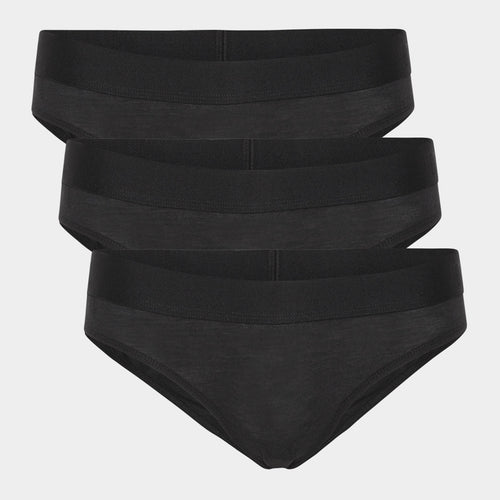
The fibres are smooth on the surface and round in cross section, unlike many other fibres that have sharp edges and uneven surfaces. See bamboo underwear for women. That is why the fabric feels cool and smooth against the skin, and the same trait lets it glide easily over the skin without scraping or irritating during movement.
Dyeing happens late in the process
The yarn or the finished fabric is usually dyed after spinning, a step that needs precise temperature and time so the colour holds without damaging the smooth surface of the fibre. A poor dyeing process can make an otherwise soft fibre stiffer, one of the reasons quality can vary between different makers of the same fibre type.
Water use and chemicals in production
The process uses both water and chemicals to dissolve and shape the fibres, and the amount varies a lot between factories depending on how modern the equipment is. Newer plants can reuse part of the chemicals in closed loops, while older plants typically use more of both to reach the same result in the finished yarn.
The difference between viscose and lyocell
Bamboo viscose is the most common fibre form, but the same plant can also be processed into lyocell, where the chemicals are reused in a closed system rather than released. Lyocell costs more to produce but often gives an even more even fibre. Most bamboo products in ordinary clothing are still viscose rather than lyocell.
How to keep the fibre's traits intact
Because the smooth fibre is sensitive to high heat and hard mechanical handling, the fabric stays soft longest with low wash temperature and gentle spinning. Using hot water or a tumble dryer often makes the fibre lose some of its natural smoothness over time, even when the knit and the seams are still intact.
Frequently asked questions
Is bamboo viscose a natural material?
The raw material is a plant, but the fibre is made chemically through dissolving and spinning. It is therefore called a regenerated fibre, not a pure natural fibre.
Why is bamboo viscose so soft?
Because the fibres are smooth and round in cross section, which gives less friction against the skin than fibres with sharp edges and an uneven surface.
Are all bamboo fabrics viscose?
Almost all. There is also mechanically made bamboo linen and chemical lyocell, but both are rarer in ordinary clothing than viscose.
You can find the full range at Bamboo-Clothing.com.