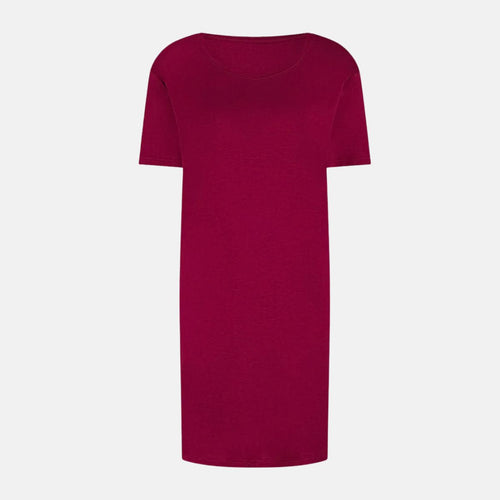
Nightwear and allergy and what you can rule out yourself
Short answer: If your skin reacts at night, the cause is most often detergent, fabric softener or house dust mites. The material of your nightwear is less often to blame, and the possible causes can be ruled out one at a time.
Start with the detergent
Try a fragrance-free detergent and an extra rinse for two weeks. It is the cheapest test and solves many cases, because traces of fragrance and detergent stay in the fabric and sit against your skin all night. Use a little less detergent than recommended, so there is less to rinse out. See washing and care.
Drop fabric softener entirely
Fabric softener leaves a film of softening agents, often perfumed, right against your skin all night. Drop it completely during the test, for both nightwear and bedding. Bamboo viscose is soft on its own and does not need softener, so you lose nothing. Many people find the fabric actually feels better without it.
Bedding before nightwear
You have more bedding against your skin than nightwear, and it is often changed less frequently. Wash it at 60 degrees a few times if dust mites are the suspicion, and change it more often during the test. Remember the pillow and duvet too, which are easily forgotten. See bamboo bedding.
One thing at a time
If you change detergent, bedding and nightwear all at once, you will not know afterwards what helped. Change one thing, give it two weeks and note how your skin feels. It takes a little longer, but it gives you an answer you can use and take with you to the doctor.
Dyes and new clothing
New clothes can carry residues from production, and dark colours may release a little dye at first. Always wash new nightwear before wearing it, ideally twice. If you only react in dark nightwear, that may be a clue, and a light set is worth trying.
Heat and sweat
Skin often itches more when it is warm and damp. A thick set under a warm duvet can cause itching that has nothing to do with allergy. Try a thinner set and a cooler duvet before drawing conclusions. A light fabric that does not cling can make the night more comfortable.
Seams and labels
Sometimes it is not the fabric but a seam or a neck label that irritates the skin in one spot. Notice whether the reaction appears in the same place each time. Cut the label off, and choose nightwear with flat seams if your skin is sensitive.
When it does not help
If it does not settle after you have ruled out detergent, softener and bedding, it belongs with a doctor. Clothing choices can make the night more comfortable, but they do not provide a diagnosis or replace an examination. Soft nightwear without tight edges is in bamboo nightwear for women.
The order in short
Start with the detergent and an extra rinse. Drop the softener. Wash the bedding hot. Wash new clothes before wearing. Check heat, seams and labels. Change one thing at a time and give each change two weeks. If none of it helps, talk to your doctor before trying more on your own.
Frequently asked questions
Can you be allergic to bamboo viscose?
It is rare. Night-time reactions are more often caused by residues of detergent, fabric softener or dyes. If you are unsure, talk to your doctor.
Does an extra rinse help with itchy skin?
Often, yes. Detergent left in the fabric is a common cause of irritation at night, and an extra rinse removes much of it.
When should you see a doctor?
When the itching or rash does not go away after you have ruled out detergent, softener and bedding. Clothing can ease things but gives no diagnosis.
See our range of bamboo sleepwear.