How to read the percentages on a care label
Short answer: The fibers are listed in descending order, and the largest share determines how the fabric feels. Care, however, follows the most sensitive fiber.
The order matters
If the label says seventy percent viscose and thirty percent cotton, viscose is the dominant fiber and mostly determines how the fabric feels and behaves. If the numbers are reversed, the fabric's character changes entirely. Always read the first number, since it tells you far more about what you are actually getting than the rest of the list.
When elastane comes last
Elastane usually appears as the last and smallest number on the label. Two to five percent sounds like very little compared with the other fibers. See bamboo underwear for women. Even so, that share is enough to completely change the fit, because it decides whether the garment holds its shape throughout the day.
The care symbols
The tub with a number shows the maximum wash temperature the garment can handle safely. The triangle covers bleach, the square covers drying, and the iron shows how much heat you can apply. A line under a symbol means gentle treatment, meaning a shorter cycle and lower spin, no matter which symbol the line sits under.
Wash for the weakest fiber
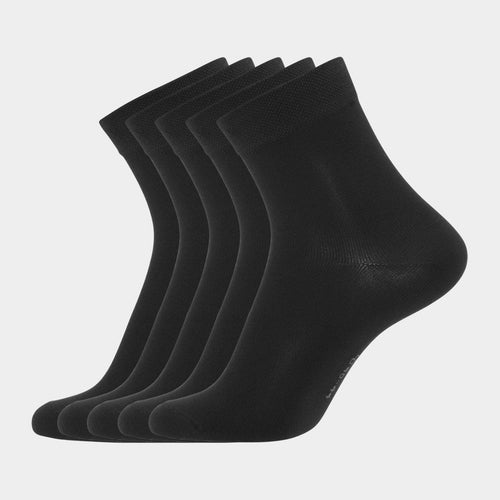
If a garment contains elastane, wash it cold regardless of what the other fibers can otherwise handle. Elastane is always the fiber that breaks down first under high heat. See bamboo socks for women. The rest of the fabric might tolerate more, but that does not help the garment as a whole.
What viscose actually is
Viscose is not a plant but a process. The cellulose is dissolved chemically and then spun into new fibers, regardless of whether the raw material is bamboo, beech, or eucalyptus. See bamboo clothing for women. That is why two garments with the same fiber listing can feel completely different, since the processing and yarn fineness matter just as much as the raw material itself.
Why the raw material is not always named
The legal requirement on the label is the fiber type, meaning viscose, cotton, or elastane. Which plant the viscose comes from is voluntary information that the maker can choose to highlight or leave out. That is why you sometimes see bamboo mentioned clearly on the packaging but nowhere on the care label inside the garment itself.
Link between share and price
A high viscose content typically costs more to produce than a high cotton content, because the process behind viscose is more demanding. That does not automatically mean a more expensive garment, but it is part of the explanation for why two seemingly identical pieces can carry different prices, even within the same brand and collection.
How to check a label quickly
Look first at the top number, which tells you what the fabric is mainly made of. Then look at the bottom number if elastane is present, since it governs the wash temperature. Finally check the symbols for drying and ironing, so you avoid damaging the garment purely by accident.
What to do if the label is cut off
If the label has been cut off or the text has worn away, a good rule of thumb is washing at thirty degrees with no fabric softener, which suits most bamboo blends. Always take a photo of the label before cutting it off, so you still have the information saved in case you are ever unsure later.
Frequently asked questions
What does viscose mean with no other word before it
It means it is a regenerated cellulose fiber. The raw material can be bamboo, wood, or other plant matter, and the word viscose alone does not say which plant was used.
Should the label be cut off
You can, but then you permanently lose the care instructions. Take a photo of the label first, so you still know the correct wash temperatures afterward.
Why doesn't bamboo appear on every bamboo item
Because the legal requirement on the label is the fiber type, meaning viscose. Bamboo as the raw material is voluntary information that the maker can choose to highlight or not.
You can find the full range at Bamboo-Clothing.com.